

Department of Nursing, Fukuoka University School of Medicine
Fukuoka University FY2025 Simulation-Based Interprofessional Education (IPE) Workshop for Nursing, Medicine, and Pharmacy
Introduction.
Developing "interprofessional collaboration skills" is a core theme in modern healthcare education. The learning objectives go beyond simply acquiring knowledge to include "learning with and from other professions," and the importance of honing practical skills starting in undergraduate education is being emphasized worldwide.As healthcare becomes increasingly sophisticated and complex, it is essential for professionals such as physicians, nurses, and pharmacists to have opportunities to think collaboratively across professional boundaries from their student days in order to deliver high-quality, patient-centered care.
Fukuoka University comprises two faculties and three departments—the Faculty of Medicine (Department of Medicine and Department of Nursing) and the Faculty of Pharmacy (Department of Pharmacy)—providing a solid foundation for training key healthcare professionals.To make the most of this educational environment, the university regularly holds interprofessional education (IPE) workshops involving all three departments. This academic year, the Department of Nursing took the lead, implementing an experiential program that combined VR (virtual reality) technology with scenario-based simulations to allow students to gain a firsthand understanding of effective collaboration. This article details the specifics of this initiative and the students’ reactions.
1. Purpose and Objectives of the Workshop
The primary objective of the workshop was to foster a deep understanding of the practical aspects of interprofessional collaboration and to help participants acquire the fundamental skills required in clinical settings, such as communication, decision-making, and the division of roles. Using the core competencies advocated by IPEC (Interprofessional Education Collaborative), an organization dedicated to promoting IPE, as a guide, we established five specific learning objectives unique to this program.
1) Demonstrate an attitude that respects the perspectives and values of other professionals and contributes to patient-centered decision-making. (Values and Ethics)
2) Determine the direction of discharge support based on the patient’s and family’s wishes, their life circumstances, and ethical considerations. (Patient-centered decision-making)
3) Understand the specialized nature of one’s own role and be able to propose an appropriate division of labor that takes into account the strengths and limitations of other roles. (Roles and Responsibilities)
4) Organize and communicate necessary information, and build discussions while incorporating feedback from other disciplines. (Interprofessional communication)
5) Can actively participate in the processes of effective team management (sharing goals, reaching consensus, and clarifying roles). (Teamwork)
2. Workshop Overview
The workshop, held on February 27, 2026 (3 hours), was attended by a total of 49 students from three departments who were selected through an open call.The breakdown was as follows: 27 students from the Department of Nursing (3rd and 4th years), 8 students from the Department of Medicine (4th and 5th years), and 14 students from the School of Pharmacy (4th and 5th years). The specific year levels for each department were determined in consultation with the faculty advisors of each department, taking into account the practical experience required to engage with the workshop content.
The workshop provided a learning experience based on multi-stage simulation training that combined a "shift in perspective" enabled by VR technology with the "sharing of clinical reasoning" through scenario simulations (mock conferences).
3. The Learning Process and Changes in Students
① Readiness Assessment and Conceptual Understanding of IPE
At the outset, we assessed and shared each participant’s readiness regarding IPE. We created an opportunity to establish a shared understanding that interprofessional collaboration is a strategic partnership aimed at maximizing patient outcomes, as well as the expected results. We then discussed the purpose, benefits, and methods of interprofessional collaboration.
② VR Experience: Seeing Things from the Patient’s Family’s Perspective
Before delving into specialized discussions, we had students experience the reality of home healthcare through a VR simulation (first-person perspective) from the viewpoint of “the patient’s son.” The aim was to ensure that, before students began applying their respective areas of expertise, they shared a common understanding of “patient-centered care”—the foundation of Interprofessional Education (IPE)—and considered, from the same perspective, “what the patient and family are feeling and what concerns they have in that moment,” thereby returning to the fundamentals of care.
While healthcare professionals typically focus on gathering “objective information,” VR presented the family’s feelings—such as “confusion over the speed of the explanation,” “a sense of alienation from technical jargon,” and “a vague anxiety about continuing care at home”—as “subjective information” accompanied by physical sensations.
During the post-experience discussion, participants went beyond superficial insights such as “the importance of clear explanations” to offer concrete insights into the details of the collaboration process, such as “if we don’t establish a unified approach among the various professionals before explaining things to the family, we’ll only cause them additional anxiety.” By adopting the perspective of the patient’s family, the focus of the discussion shifted from “the convenience of the medical staff” to “the real-life experiences of the patients and their families.”
③ Practice and Dialogue: Strengthening Multidisciplinary Collaboration Through a Mock Conference on Discharge Support for Heart Failure Patients
For this training session, we developed a scenario titled “Supporting the Discharge of Patients with Heart Failure,” which requires a highly multifaceted approach. We selected this case because heart failure is a condition characterized by recurring episodes of exacerbation and remission; preventing readmission is difficult unless pharmacotherapy (pharmacists), family support and lifestyle guidance (nurses), and treatment decision-making (physicians) are closely coordinated. Participants were provided with two A4-sized pages of background information in advance and were then presented with the following simulation task.
You are a member of the team leading the discharge conference for a male patient in his 70s with heart failure who was admitted due to an acute exacerbation. The conference has two objectives: [to ensure a safe post-discharge life] and [to establish a multidisciplinary collaboration plan to prevent readmission]. Please participate in the conference (1 minute) with a clear understanding of how your profession can contribute to the team.In this simulation, one or two representatives from each department will participate, acting in their respective professional roles.
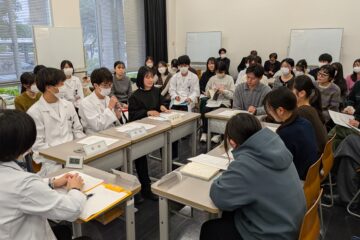
In the first session, participants tended to focus solely on conveying their own professional perspectives, resulting in a discussion that remained superficial.However, in the second session, following a review of the first session, two-way dialogue centered on “relying on and utilizing the expertise of other professions” became more active. For example, the pharmacist role requested that the nurse role “monitor fluid intake,” and the nurse role asked the physician role to “reassess the future treatment plan.” This led to the formulation of high-quality collaboration guidelines aimed at preventing readmissions.
4. Reflection: Fostering "Respect" Across Disciplines
During the post-workshop reflection session, a common challenge across all departments—a lack of understanding of other professions’ roles—came to light; however, more importantly, a deep understanding of and respect for each other’s expertise had begun to take root.
Nursing students commented, “Nurses are the ones who know patients’ personal backgrounds best. I strongly felt the responsibility to act as a coordinator who shares information with other professions and respects the patient’s wishes.” Medical students remarked, Medical students commented, “I truly felt firsthand that students from other disciplines are also honing their specialized skills. I want to remember today’s experience so that I don’t become a self-centered doctor (like the one depicted in the VR simulation) in the future.” Pharmacy students remarked, “I reaffirmed my identity as a pharmaceutical expert. Ahead of my clinical rotations, I want to re-examine what I can do for the team.”
5. Conclusions and Future Directions
During the workshop, the initial VR-based exercise on “empathic understanding” helped anchor the discussion firmly around the “values of patients and their families.” Through the scenario-based simulation exercises in the next phase, participants were able to engage in equal dialogue across professional boundaries, rediscover their own expertise, and enhance their motivation to learn about their professional roles and future career paths.
Ideally, this type of interprofessional education should be made mandatory as part of the regular curriculum. However, given the tight schedules of each department, there remain many challenges—both logistical and structural—in coordinating such programs. While participation is currently voluntary, the educational benefits gained from this initiative have been significant, and I am confident that it will serve as a valuable model for undergraduate education.
Moving forward, even within the constraints of limited time, we intend to refine our approach by utilizing a variety of methods to maximize learning outcomes, and we aim to continue providing opportunities for students to experience the "essence of interprofessional collaboration."
-
A glimpse of the VR experience
-
A scene from the mock conference