

Let's learn in the place where we live! ~Nursing Staff Post-Graduation Follow-up Training~.
Ritsuko Yamada, Dean, College of Nursing and Social Work, Hokkaido University of Health Sciences
As the shift from hospital-based to community-based care continues, the importance of nursing care that focuses on the "living" of the recuperator is growing. Hokkaido University of Health Sciences, as a regional activity project of the Japan Association of Private Nursing Colleges, implemented "Let's learn at the place where people live" in FY2024! -Postgraduate Follow-up Training for Nursing Staff" in FY2024. This training program was designed for nursing staff in the first to fifth year after graduation who lack experience in home nursing practice to learn about the actual lives and health of home care patients and their families.
[Creation of a learning network through university collaboration system and partnership with home health care nursing stations].
It was hosted by the Faculty of Nursing and Social Welfare of Hokkaido University of Health Sciences, in collaboration with four other universities: Tenshi University, Hokkaido University of Science, Nihon University of Health Sciences, and Hokkaido Bunkyo University. Under a cooperative system among the universities, training was conducted at home health care nursing stations in Sapporo and its suburbs (Hokkaido University of Health Sciences Visiting Nurse Station, Visiting Nurse Sakura Station, Sapporo Higashi Tokushukai Visiting Nurse Station, and Teishin Kai East and North Stations). Twenty-seven people, mostly graduates, applied for the program, and 25 participated.
[Accompanying them to places where they live and learn the essence of nursing].
After an orientation in November 2024, the accompanying visits were conducted from December to March of the following year. Trainees accompanied home care nurses to the homes of homebound convalescents to observe their living conditions and the implementation of support. They learned experientially how to provide nursing care that is close to the lives of the convalescents and their families.
A debriefing and review meeting was held on March 10, 2025, where 22 trainees shared their experiences. In the group discussion, participants shared diverse learnings, such as "I was able to learn about the realities of life that are difficult to see in hospital wards," and "I realized the breadth of home-visit nursing and the importance of cooperation.
High level of satisfaction among participants and future prospects.
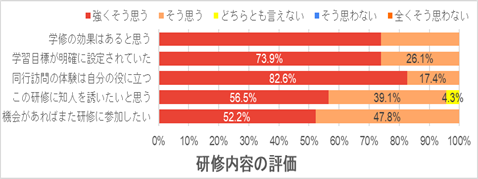
In the post-training questionnaire, the overall satisfaction rate for the training was high at 97%, with 100% of the respondents saying that the training was effective, that the learning objectives were clear, and that the accompanying visits were useful to them. In the free responses, many participants reaffirmed the importance of nursing that respects the lives and values of the patient and his/her family. Many of the participants were motivated to "incorporate the perspective of home care into discharge support in the hospital wards" and "support patients to realize the life they desire," indicating the evolution of their own views on nursing and positive changes in their career development.

New bridges between universities and practice.
This training program is also an effort to build a new network linking education and practice through collaboration among universities and with clinical sites. In the future, it is expected to further strengthen cooperation with local medical institutions and visiting nursing stations to promote the seamless provision of nursing care from the hospital to the community.
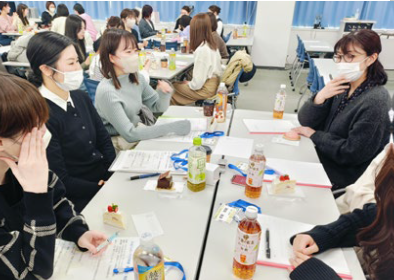
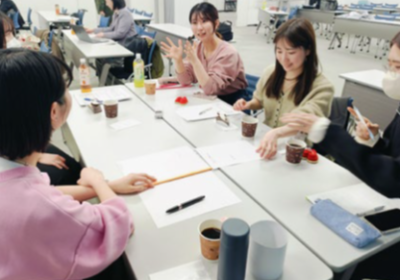
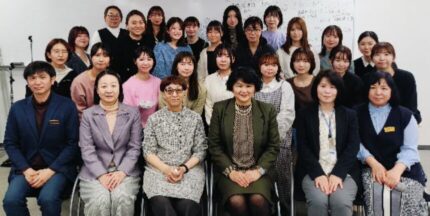
(Photo) Reporting and review meeting. During the group discussion, participants shared their learnings and discoveries from the visit and gained new insights from each other's experiences. Participants said it was a valuable opportunity to review nursing from the perspective of consumers, and took commemorative photos with smiles on their faces.
Acknowledgments] This project is a model project funded by a District Activity Project grant from the Japan Association of Private Nursing Colleges and Universities. The grant enabled us to create meaningful opportunities for nursing staff to learn and contribute to comprehensive community care in a "living place". We hereby express our deepest gratitude.