Osaka Medical and Pharmaceutical University, School of Nursing
From March 17 to 26, 2025, two of our faculty members visited three universities in Belgium and Austria to discuss actual international nursing education and possible future collaboration.
First, at Thomas More University of Applied Sciences (Belgium), the students received an overview of nursing and midwifery education and observed a simulation class for depressed patients. The design of the space to encourage student interaction and the emphasis on the ability to interact with the subject were impressive. During the "International Days," students interacted with nursing faculty from various countries, and TUFS gave a lecture on "Understanding Diversity in Japanese Health Care. At the Antwerp campus, the participants attended lectures on "superdiversity," learned about global health education, and discussed future collaboration possibilities such as summer school and COIL (Collaborative Online International Learning). The possibility of future collaboration in summer school, COIL (Collaborative Online International Learning), etc. was discussed.
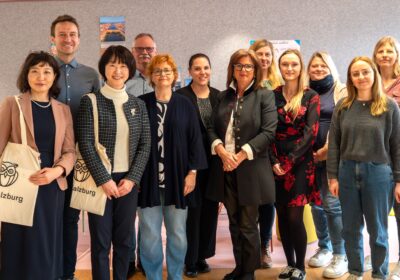
Next, we visited the Salzburg University of Applied Sciences (Austria). The university is blessed with a natural environment and designed to emphasize student wellbeing, featuring simulation education based on the three pillars of Fidelity, VR, and Acting, using more than 500 VR scenarios developed in collaboration with a Canadian company. In the field of psychiatric nursing, systems that take human rights into consideration (e.g., mandatory reporting of physical restraints) are in place, while issues remain in home nursing and day care. In the future, we will consider collaboration through cooperation in online modules.
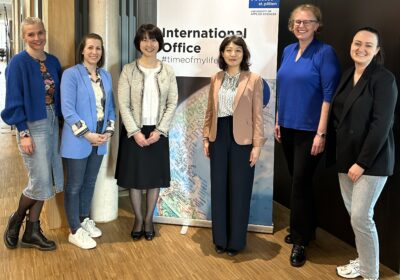
Finally, the group visited St. Pölten University of Applied Sciences (Austria) to observe the educational system at the multi-faculty university with approximately 4,000 students. The School of Nursing has an international curriculum with VR-based education and mandatory online modules. The school of nursing has an international curriculum with VR-based education and mandatory online modules. Although some lectures are given in English, short-term exchanges in the form of peer tutoring are possible, and the school expressed interest in accepting students from Asian countries. At the affiliated hospital, we were able to confirm a well-developed medical system equipped with dialysis, emergency services, and a heliport.
Through this visit, we reaffirmed the diversity of educational content, the culture of respect for student autonomy, and the importance of collaboration with the local community and other disciplines. In the future, we look forward to the development of sustained academic exchange through summer programs, online lectures, and short-term dispatches.